Understanding Breast Augmentation Complications: Limitations of Implants vs. Fat Grafting and the Role of SVF-Based Approaches
When considering breast augmentation,
the primary concern for most patients is the risk of complications.
While implant-based augmentation has long been the conventional approach,
its structural limitations related to foreign body reactions remain.
On the other hand, autologous fat grafting offers a more natural alternative,
but presents challenges associated with fat survival.
This article provides a structured and objective overview of
the limitations of implants and fat grafting,
as well as the medical significance of SVF (Stromal Vascular Fraction)-based breast augmentation.
1. Structural Limitations of Breast Implants

Breast implants allow for predictable volume enhancement; however,
as foreign materials introduced into the body,
they inherently carry several limitations:
- Capsular Contracture
: Hardening due to excessive fibrotic capsule formation - Foreign Body Reaction & Chronic Inflammation
: Potential for persistent discomfort or pain - Unnatural Texture and Shape
: May vary depending on patient anatomy - Durability Issues
: Risk of rupture or deformation over time - Post-removal Deformity
: Tissue stretching and contour irregularities
These complications are not merely technical issues,
but stem from the fundamental nature of implant insertion.
2. Key Challenge in Fat Grafting: Survival Rate

Autologous fat grafting is advantageous in terms of
biocompatibility and natural feel.
However, the most critical clinical factor is
the fat survival rate.
- A significant portion of grafted fat is naturally resorbed
- Delayed vascularization can lead to fat necrosis
- Necrosis may result in calcification or oil cyst formation
- Multiple sessions may be required for desired volume
Ultimately, the success of fat grafting depends on
how much of the transferred fat survives,
which is closely related to the microenvironment of the graft site.
3. SVF-Based Breast Augmentation: A Biological Approach

To overcome these limitations,
SVF (Stromal Vascular Fraction) has gained attention.
SVF is a heterogeneous cell population derived from adipose tissue,
with the following biological properties:
- Promotes angiogenesis (new blood vessel formation)
- Enhances tissue regeneration
- Contains growth factors and regenerative signaling components
▶ Core Process of SVF-Based Augmentation
- Isolation of purified adipocytes from harvested fat
- Extraction of SVF from the same adipose tissue
- Recombination at an optimal ratio followed by grafting
This approach goes beyond simple fat transfer,
by creating a biologically supportive environment for graft survival.
4. Determinants of Fat Survival: The Importance of Protocol
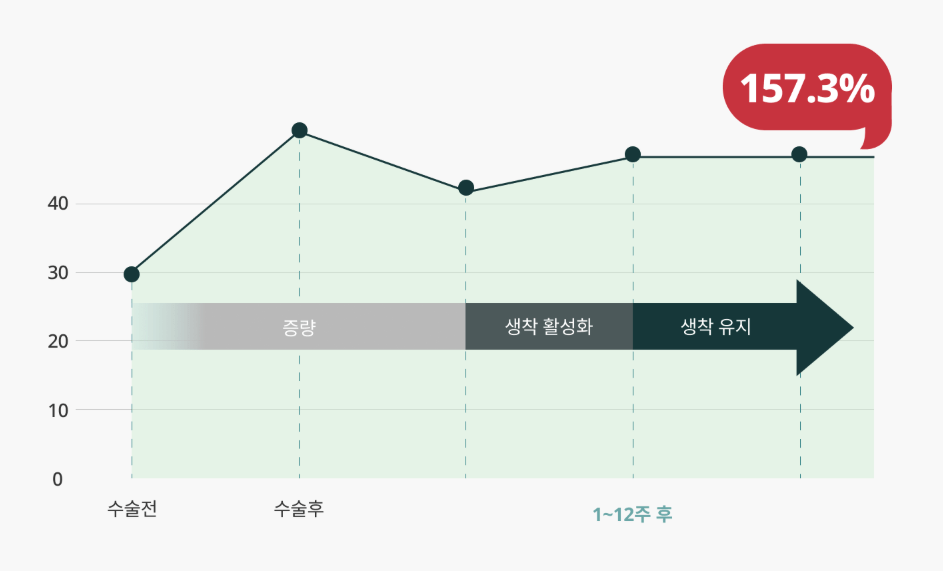
It is important to note that
the use of SVF alone does not guarantee high survival rates.
Clinical outcomes depend on a combination of factors:
- Preoperative Management
: Optimizing fat quality through diet and metabolic condition - Harvesting Technique
: Minimizing cellular damage during extraction - Processing & Ratio Optimization
: Precise balance between adipocytes and SVF - Postoperative Care
: Maintaining vascular stability and graft environment
Therefore,
the outcome is determined not just by the technology, but by the completeness of the protocol.
5. Caution: Misleading “Stem Cell” Procedures
Some clinics may promote PRP (Platelet-Rich Plasma)
as a form of stem cell therapy.
However, PRP:
- May assist in tissue recovery
- But has limited capability in angiogenesis and fat survival enhancement
As a result, outcomes may not differ significantly
from conventional fat grafting.
Thus, when considering SVF-based procedures,
it is essential to verify whether
authentic SVF extraction and application are performed.

The safety and effectiveness of breast augmentation
are not determined solely by choosing between implants and fat grafting,
but by evaluating:
- Biological stability
- Tissue adaptability
- Long-term sustainability
In particular, for fat grafting,
the design of the graft survival environment is critical,
which depends on clinical expertise, technology, and systematic protocols.
If you are considering breast augmentation,
focus not only on the method itself,
but also on evidence-based approaches and experienced medical systems.
#Breast Augmentation
#Fat Grafting
Official Website:
https://www.sc301.co.kr
 SC301의원
댓글 남기기