Understanding Post-Thermage Reactions and Timeline of Clinical Effects
Thermage, a radiofrequency-based skin tightening procedure, has become widely recognized for improving skin laxity and facial contour. However, despite its popularity, many patients lack a clear understanding of the physiological responses following treatment and the timeline of visible results.
In particular, transient swelling, heat sensation, and delayed onset of effects are often misunderstood, which may lead to unnecessary concern. Therefore, a precise understanding of these processes is essential.
Mechanism of Post-Treatment Swelling and Heat Sensation
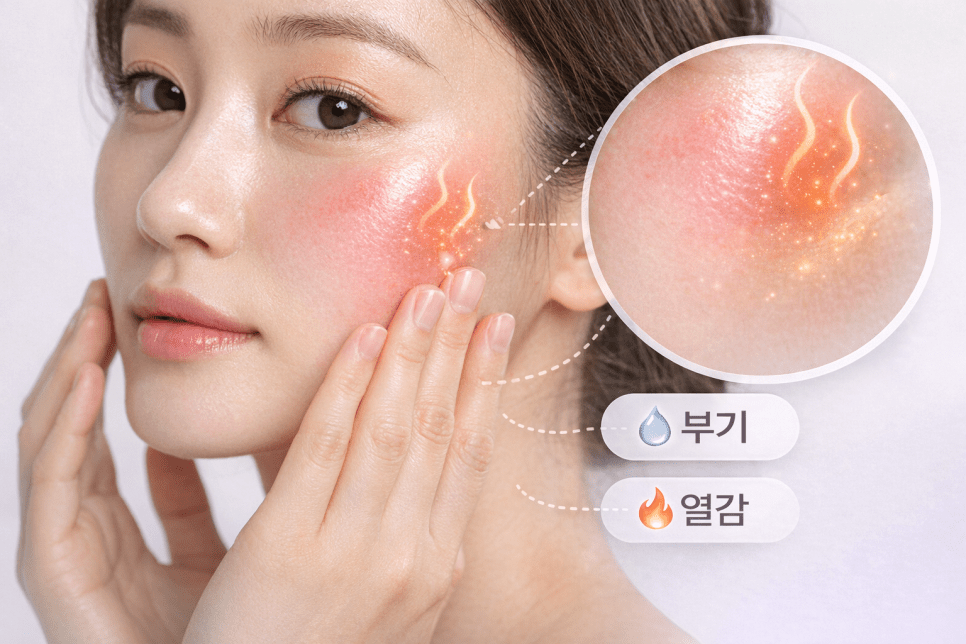
Thermage utilizes radiofrequency (RF) energy to deliver controlled thermal stimulation to the dermal layer, inducing collagen denaturation and subsequent remodeling.
This thermal effect triggers several physiological responses:
- Transient erythema due to vasodilation
- Mild edema caused by interstitial fluid shifts
- Localized warmth resulting from thermal stimulation
These responses should not be interpreted as adverse effects, but rather as part of the initial phase of tissue repair and regeneration.
In most cases, erythema and swelling subside within a few hours, and typically resolve within 1 to 3 days. While individual variation exists depending on skin sensitivity and treatment parameters, prolonged or severe reactions are uncommon in clinical practice.
Collagen Remodeling and Onset of Clinical Effects

The primary mechanism of Thermage is not immediate structural lifting, but rather delayed neocollagenesis.
Immediately after treatment, contraction of existing collagen fibers may produce a temporary tightening effect; however, this represents only a limited and short-term change.
The true regenerative process follows a gradual timeline:
- 2–4 weeks: Activation of fibroblasts and initiation of collagen synthesis
- 4–6 weeks: Progressive increase in dermal density and elasticity
- 1–3 months: Clinically noticeable improvement in skin firmness and contour
For this reason, Thermage is often described as a “time-dependent rejuvenation procedure.”
Duration of Results and Influencing Factors

The newly formed collagen structure is maintained for a certain period, with clinical effects generally lasting 6 to 12 months.
However, the longevity of results may vary depending on several factors:
- Baseline degree of skin aging
- Cumulative ultraviolet (UV) exposure
- Lifestyle factors (sleep, smoking, nutrition)
- Skin hydration and post-procedure care
Thus, long-term outcomes are influenced not only by the procedure itself, but also by patient-specific biological and environmental factors.
Importance of Post-Treatment Care

Following radiofrequency treatment, the skin may exhibit temporarily increased sensitivity. Appropriate aftercare is therefore essential:
- Sun protection: Prevents photoaging and collagen degradation
- Adequate hydration: Supports skin barrier recovery
- Minimizing physical and thermal irritation: Avoid excessive friction and heat exposure
Proper post-treatment care helps optimize the environment for collagen remodeling and contributes to improved durability and overall satisfaction.
Considerations in Treatment Planning
The outcome of Thermage is not determined solely by the device itself. Even with the same technology, results may vary significantly depending on:
- Skin thickness
- Fat distribution
- Pattern and degree of laxity
- Individual aging characteristics
Therefore, a comprehensive assessment of the patient’s skin condition and a personalized treatment strategy are critical for achieving optimal results.
Thermage is not merely a mechanical lifting procedure, but rather a biologically driven intervention that stimulates collagen regeneration within the dermis.
Post-treatment swelling and heat sensation are normal physiological responses, and the clinical effects develop progressively over time.
Ultimately, a clear understanding of the underlying mechanisms, combined with appropriate aftercare, is essential for achieving safe, predictable, and satisfactory outcomes.
 SC301의원
댓글 남기기